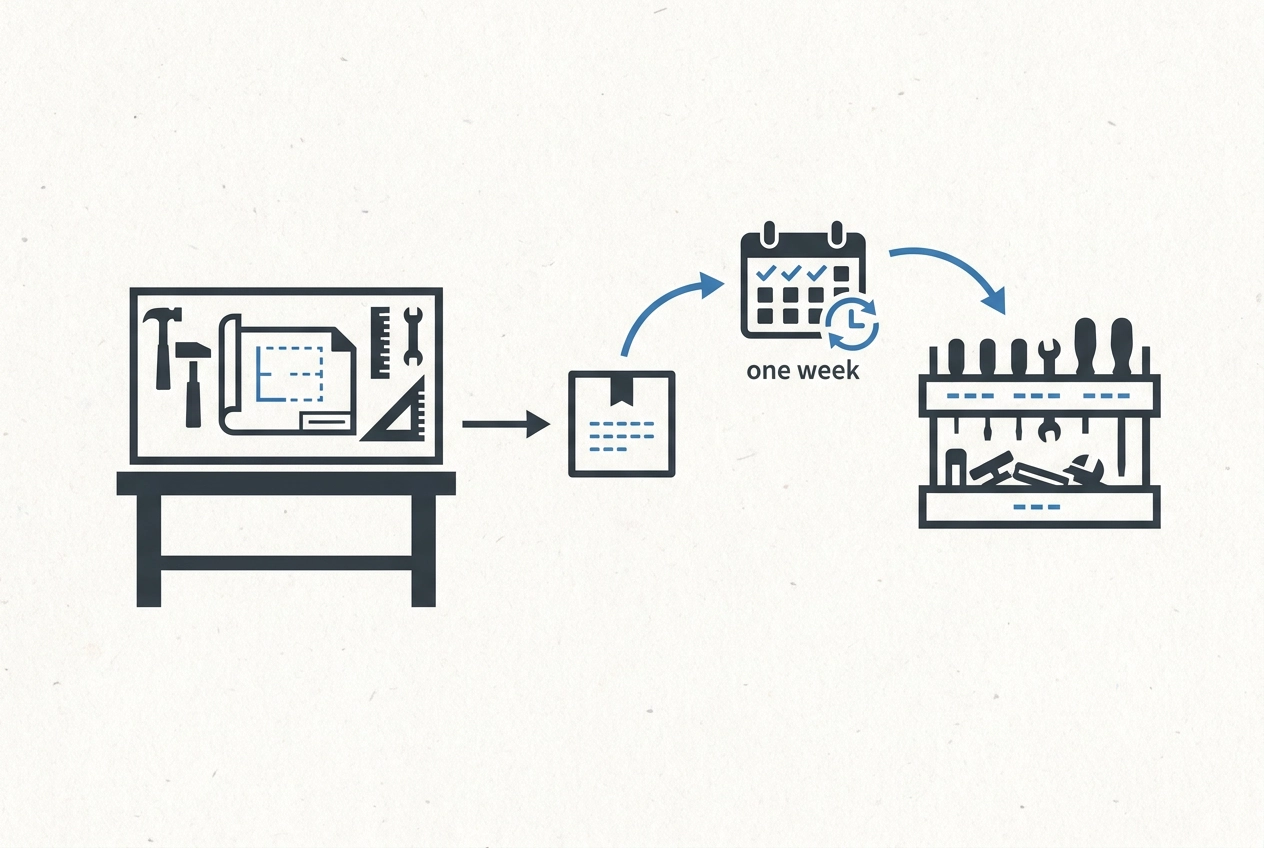
There is a part of the job that irritates you every single week. Maybe it is the part that is never on the truck. Maybe it is the callback nobody wants to make twice. You do not need a conference room, a binder, or a fancy system to fix it. Our plain version: kaizen process improvement at its simplest is find one annoyance, change one step, and check next week whether it stuck.
In this post, we will look at why kaizen sounds like more work than the work, why a change nobody checks is just a wish, and the three things you already have. Then we will go step by step: name the one annoyance you repeat most, change one step rather than the whole job, and check next week whether it stuck. We will also cover what to do when the change did not stick, why the weekly habit beats a formal improvement initiative, and how to keep the habit without a binder. By the end, you will have one change to try this week and one check to make next week. That follow-up is what makes it real for a small shop.
Why Kaizen Sounds Like More Work Than the Work
Say "kaizen" to most owners and they picture a kickoff meeting, a three-ring binder, a chart on the wall, and a promise to keep it up that lasts about three weeks. The objection is fair, too. In a shop of five, every hour is already spoken for, and anything that looks like a formal improvement initiative will lose to a job that needs doing.
Our plain version: kaizen is small change, checked. That is the whole idea you need to run it in a five-person shop.
The one part worth borrowing from the wider kaizen process improvement world is that the disciplined version is a systematic test of a change, followed by adoption of what actually worked, not a long discussion about what might work. That test-and-keep habit is the lean idea behind this, without the jargon.
One precondition carries everything else: our view is that if you do not check it, you cannot improve it. The check next week is the measurement. Without it, a change is just an opinion.
This piece leaves out DMAIC, A3 forms, value stream mapping, facilitators, and consultants on purpose. What follows is the version that fits a busy week.
A Change Nobody Checks Is Just a Wish
Here is our operating view, and it is a view, not a research finding: the check next week is what makes a change real. Without it, you have a wish.
Two sentences sound identical and are not. "We tried that once" means somebody changed something and moved on. "We looked at whether that worked" means somebody came back and asked. Only the second one teaches you anything.
The check can be thin. One question, same day each week: did the annoyance show up again this week?
For a trade shop, the smallest useful measures are counts you already know: repeat trips back to the shop or the supplier, calls chasing a part that never made the truck, minutes lost re-entering an invoice by hand. Say them out loud, write them down, and compare.
That is our operating view, and the wider kaizen world agrees -- but the weekly one-change habit is simply how we'd run a shop.
Now think about the folder of good ideas on your shelf. Nobody ever asked anyone to confirm whether those ideas worked, so nobody looked. A change with no check joins that folder.
Before You Start: Three Things You Already Have
You need three things, and you already own all of them.
Something to write on. A notebook in the truck, a note on your phone, or a whiteboard by the shop door. Not a new app. If your operation still runs on paper and texts, that is fine; the approach here is built to work with what you have.
Five minutes, same day each week. Pin it to something you already do, like the Friday invoice run or the day you order parts. In our experience, five minutes attached to an existing chore survives; five minutes you have to go find does not.
The willingness to be wrong next week. A change that fails and gets recorded beats a change nobody looks at again.
You do not need a team meeting, a facilitator, a budget, a policy, or unanimous agreement from the crew. You need one reusable sentence: the annoyance, the change, what happened. Writing it takes seconds.
Step 1: Name the One Annoyance You Repeat Most
Now pick the annoyance. Not the one that would look good on a chart, but the one you complained about most in the last two weeks. For most shops it is the part that is never on the truck or the callback nobody wants to make twice (more examples in the intro). Repeats like those usually trace back to parts, scheduling, or a gap between the field and the office, not to effort.
Test a candidate with three questions:
Does it happen every week?
Does one person own it?
Can you describe it in one sentence?
Three yeses means write it down with a count attached: "Three times last week we drove back for a part that was not on the truck." The count turns a gripe into something you can check later.
Screen out anything that needs a new hire, a new truck, or three people to agree. Those are projects, not this week's change.
Pick exactly one. Two annoyances means two changes, and two changes next week is a programme again. One name, written down, and you're ready for the next step.
Step 2: Change One Step, Not the Whole Job
You have your one annoyance. Now change one step inside that job and leave the rest of it exactly as it is. The change has to be small enough to keep going during a busy week, not big enough to impress anybody.
One step looks like this: photograph the packing slip before the truck leaves the yard. Add the callback address to the job ticket. Call the supplier the afternoon before pickup day.
Write down what you changed and what you expect to see next week, right under the annoyance on the same page. Next week needs something to compare against.
Then set the change as the default, not a suggestion, and tell whoever else touches that step what is different now.
Resist buying anything to make the change. Change the process first and add a tool second, once the step has held for a few weeks.
Give it one full week before you judge it. Do not stack a second change on top while the first is still unproven.
Step 3: Check Next Week Whether It Stuck
Block the check on the calendar the moment you make the change.
Ask three questions and write the answers down:
Did we do the new step every time?
Did the annoyance still show up?
What did it cost us this week?
Stuck looks like this: the new step is the normal way, somebody else can do it without being reminded, and nobody has to think about it. Week one can't prove that last part. Research on habit formation puts automaticity weeks to months out, so this check proves repetition, not autopilot.
Where numbers help, use them. Job costing built on real labor and cost history from past jobs, which is how crew&cost works, shows whether a change moved anything on those jobs.
Keep it, adjust it, or drop it. All three are real answers. A clear no with a reason is the most useful result of the week.
If it held, make it the standard. Stop calling it a change, or it quietly slips back.
What to Do When the Change Did Not Stick
A change that did not hold is information, not failure. Run it through four checks before you move on.
Size. In practice, most changes that fail were two or three steps wearing a disguise. Cut yours in half and try the smaller version next week.
Ownership. If the new step depended on somebody remembering it, and that somebody was never named, it was nobody's job. Name the person.
Timing. A step that fights your busiest hour will lose. Move it earlier, later, or to a different point in the day.
The check. If nobody confirmed anything, the change never had a chance. The fix is the check, not the change.
None of this is laboratory science, just the order that usually finds the problem. Then keep the note. Write down what you tried and what happened. When the same idea comes back around in six weeks, as it often does, you can point at the page instead of re-arguing it. One missed update can create a chain of wrong decisions in the same way.
Finally, do not let one failed week end the habit. Next Monday is simply the next change, not a verdict on the practice.
Why the Weekly Habit Beats a Formal Improvement Initiative
One missed week is data, not a verdict -- and the weekly habit is built to absorb it. In our experience, formal kaizen work needs a cadence, a coordinator, and hours carved out of production. In a shop of five, nobody is spare to be the coordinator. The person who would run it is also the person on the truck.
In our experience, programs usually die at the follow-up, not the kickoff. Kickoffs happen because they're scheduled and visible. The check six weeks later happens only if somebody made it a job. Our operating view: size matters far less than whether somebody confirms next week that the change worked.
Do the arithmetic. Eight to twelve small changes a quarter, each one checked, moves further than one large project that stalls in month two. An illustration, not a study.
The formal route deserves fair treatment. Government-backed small manufacturer support and training bodies do real work and have for decades. They're built for a different size of problem and a different budget.
What no program can supply: proximity. The person making the change is already standing next to the step.
Keeping the Habit Without a Binder
The whole record is one line a week, in one place: the date, the annoyance, the change, and what happened. A spiral notebook by the shop door does it. No app, no template, no columns.
Cue it to a chore you already do -- same logic as the five-minute slot above.
Once a quarter, flip back through. The changes that stuck are the ones worth writing down as the standard way of doing that job. And when a change needs more than one person to hold it, that is the moment to document the step and hand it over properly, not before.
As a rule of thumb, if the note goes missing three weeks running, you have found your annoyance. Give it a week of its own. The habit fixes itself.
One Change This Week, One Check Next Week
Here is the whole habit in one week.
Today, write down the irritation that repeats most in your shop, in one sentence with a count: "Three times last week we drove back for a part that was not on the truck."
This week, change one step inside that job. Nothing else. Set it as the default and tell whoever touches that step. Before you close the notebook, put next week's check on the calendar, same day and time.
Next week, ask whether the step happened, whether the annoyance showed up, and what it cost. Keep what held, shrink what did not, and move to the next annoyance.
Our operating view: a shop that checks one small change a week will out-improve a shop waiting for time to do it properly. Catching one early miss also keeps it from snowballing through the rest of the job.
That is the whole practice. If your annoyances keep landing in bids, invoices, parts, and intake paperwork, 1Site2See in Heflin, Alabama builds systems around how a business already works, including crew&cost for trade contractors.
Conclusion
One annoyance, one change, one check -- and the follow-up is what makes it real. If bids, invoices, parts, and intake paperwork keep causing repeat annoyances, 1Site2See in Heflin, Alabama builds systems around how a business already works, including crew&cost for trade contractors.