Thirty-six point two million. That is the number of small businesses the SBA counts in the United States. It is more than a statistic; it is a signal about how work gets done, who does it, and where growth comes from. For an owner-operator in East Alabama or West Georgia, the national figure matters less than the local pattern. Alabama alone has 465,610 small businesses, and 390,228 of them have no employees. These are the shops most likely to run on spreadsheets, paper, and memory. That is not a flaw. It is a process problem waiting to be solved.
This analysis examines what the 2025 numbers reveal. You will learn the scale of small business in the U.S. and Alabama, the rise of owner-operators and nonemployer businesses, and where net new jobs are coming from. You will examine construction and other services in Alabama, what the data leaves out, and why work tracked in too many places becomes the bottleneck. We will cover when a spreadsheet stops being enough, how to fix the process first before adding technology, and what this looks like for a shop in East Alabama or West Georgia. We close with four actions for this week.

The Scale of Small Business: U.S. and Alabama in 2025
The SBA Office of Advocacy's 2025 state profiles put the count of U.S. small businesses at 36.2 million, or 99.9% of all businesses. That figure covers employer firms and nonemployer businesses together, so it is not 36.2 million storefronts with payrolls. Most are one-person operations.
Alabama's 2025 State Profile counts 465,610 small businesses, or 99.4% of businesses in the state. Those firms employ 816,850 people, 46.0% of Alabama's employees. "Small" is broader than it sounds: the SBA sets size standards by industry, so some firms counted here would look mid-sized to most readers.
One caveat on geography. These are state-level figures. There is no East Alabama or West Georgia breakout in this data, so any regional read is inference from the state number, not a measurement.
The money side matters too. In 2023, banks reported $84.2 billion of $242.9 billion in new lending nationwide going to businesses with revenue of $1 million or less. In Alabama, that split was $1.2 billion of $3.9 billion. Lending data shows that access to capital is concentrated at the smaller end of the revenue range.

Who Is Actually Doing the Work: Owner-Operators and Nonemployer Businesses
That 84 percent, 390,228 of Alabama's small businesses with no employees, describes most of the people reading this. That last part is an observation, not a statistic.
The owner-operator day has no wall between sales and operations. The same person answers the phone, prices the job, orders material, does the work, sends the invoice, and chases the check. That is not a workflow. It is a sequence of interruptions.
When one person holds every process in their head, the business does not have a system. It has a memory. Growth does not break that memory all at once. It breaks at the busiest moment, when a second job, a supplier delay, or a customer question arrives at the same time. That is when details go missing: a job gets priced from memory, the material list changes by text, and the invoice waits until the owner can reconstruct what happened.
The hiring pattern makes it worse. The first hire in a small shop is usually a second pair of hands, not an office person. Administrative work stays with the owner far longer than it should. That is where double entry starts: the same address, material cost, or labor hour gets typed into a bid, a spreadsheet, an invoice, and a text thread. Where This Shows Up in Trade and Service Businesses covers this pattern in more detail.
Where the Job Growth Is Coming From, and Why Process Matters More Now
That hiring pattern matters more now because small businesses are where the jobs are going. According to the SBA Office of Advocacy's 2025 U.S. State Profile, small businesses contributed 1.2 million of the country's 1.4 million net new jobs between March 2023 and March 2024, or 88.9%. In Alabama, the same profile reports 4,814 of 5,985 net new jobs over that period, or 80.4%.
Read those numbers carefully. They are net figures, covering a specific 12-month window, not a long-run average. Net numbers hide churn. Nationally, opening and expanding establishments added 14.4 million jobs while closing and contracting establishments lost 13.0 million. The sources do not break gross gains down by business size. So the honest statement is that small businesses accounted for most of the net gain, not that they created almost all the jobs. Shops that add a hire are also absorbing the turnover and losses behind that net figure.
The practical implication is straightforward. Growth lands on shops that are already thin on staff. When a 3-person outfit becomes a 4-person outfit, the payroll line is not the only cost that changes. Every new hire multiplies the cost of unclear processes. Work that one person used to carry in their head now has to cross from one person to another, and each crossing is a chance for the number to change.
The first place new headcount breaks down is handoffs. A bid gets priced by the owner, then passed verbally to the person running the job. A change order gets agreed to on the phone and never written down. A material list lives in a text thread. Detail drops between the person who priced the job and the person doing it. The job still gets done, but it gets done with rework, callbacks, and hours that never make it onto an invoice.
Trades and Services: Construction and Other Services in Alabama
For trades readers, the single most useful figure in this dataset is not the statewide total. It is the shape of construction in Alabama. The SBA 2025 Alabama State Profile counts 53,712 small construction businesses, and 45,245 of them have no employees. That is roughly 84 percent owner-operators.
The same pattern holds next door. Other Services, which covers repair and maintenance, personal services, and similar work, has 65,570 small businesses in Alabama. Retail trade has 42,285. Those three sectors, construction, other services, and retail, are where most 1 to 25 person readers sit.
Here is the observation that matters: a nonemployer contractor carries the same administrative load as a much larger company, just without the help. In our experience, bidding from memory and last year's prices is common in these shops, and the estimating history lives in the owner's head and a few old paper tickets rather than in any system.
Without job costing, money leaks in predictable places. Here is what we see in these shops: labor hours on small jobs never get captured, so the next bid is priced off a guess. Material markup is assumed rather than tracked, so the margin on a supply-heavy job is unknown until the bank account says so. Callbacks get treated as goodwill instead of as a cost, when each one is unbillable labor and a lost opportunity to fix the process that caused it. For a closer look at why generic benchmarks miss this, see Where Generic Benchmarks Break Down for Small Trade Contractors.
One geographic caveat: the Georgia state profile was not in this research set. For West Georgia readers, keep the framing regional and pull the Georgia profile before publishing any Georgia-specific number. The Alabama figures above are state-level, not local.
What These Numbers Do Not Tell You
Those sector counts describe an industry, not a single shop. That distinction matters, because the numbers above cannot do several things an owner might expect them to do.
Start with adoption. Nothing in the SBA profiles reports how many small businesses run on spreadsheets, paper, text messages, or software. There is no figure to quote. The pattern we describe, work tracked across several places at once, is an observation from how 1 to 25 person shops actually operate, not a measured statistic. Treat it that way.
Second, there is no local breakout. There is no East Alabama or West Georgia breakout; any regional read is inference from the state total. When we say "shops like yours," we mean a business type, not a surveyed population in your county.
Third, "small business" is broader than it sounds, the SBA sets size standards by industry, so these totals include firms many readers would call mid-sized. Read them as counts of classified firms, not as counts of shops the size of yours.
Fourth, the data counts shops and dollars. It does not tell you whether any particular shop's jobs make money. A business can stay busy, grow revenue, and lose money on every job it runs. Nothing in a national total captures that.
That is why a national count cannot benchmark your operation. It mixes industries, sizes, and business models. The comparison that actually changes a bid or a price is your own job history: what a job type really cost in labor and material against what you quoted. That is where the next section picks up.
The Pattern Behind the Numbers: Work Tracked in Too Many Places
That comparison starts where the job's numbers actually live. In many 1 to 25 person shops, in our experience, they live in four or five places. A phone note from the first call. A text thread about the address or gate code. A bid built in a spreadsheet. A paper ticket left in the truck. Then a bank deposit that is the only record the job ever closed. No single one of those is the job record. Together they are the job, scattered.
Walk one job end to end and you will count seven stops where the same detail gets re-entered, each one a chance to lose the number.
That is rarely laziness. It is process design. Each tool solved one problem and was never connected to the next. The seam between tools that do not talk to each other costs a re-type plus one more chance to lose the number. The Scenario That Starts It All is what happens when one missed update travels through those seams and creates a chain of wrong decisions.
The address on a customer's file gets typed into the estimate, typed again into the invoice, and typed a third time into the GPS. A material cost comes off a receipt, gets copied into a spreadsheet, then copied again into the invoice. Each copy is a place for a transposed digit to hide.
The cost is not abstract. It is unbillable hours the owner works at night, after the crew has gone home. It is bids priced off partial history because last year's labor hours were never captured. It is invoices that go out a week late because the job details are split across four places. Sign 2: You Find Out a Job Slipped Through the Cracks After the Fact is the same pattern showing up at month end, when a job that closed cleanly never made it into the books.
Where a Spreadsheet Stops Being Enough
None of that means the spreadsheet was the wrong tool. It is fast, familiar, and genuinely good at rows, sums, and one person working in a file. For a small shop, it handles plenty of math, from material takeoffs to a quick break-even check. Keep it for that.
The breaking point is not row count. It is shared use. A spreadsheet works while one person owns the file. It starts to fail when a second person needs the same information at the same time. That is when version confusion, overwrites, and stale copies enter the process.
Four signals tell you the work has outgrown the file. First, a second person needs to see the job list, not just hear about it. Second, the same data lives in two tabs that no longer match. Third, you cannot answer "what did this job actually cost" in under five minutes. Fourth, bids depend on remembering the last similar job instead of reading its actual numbers.
These are not moral failures. They are capability limits. A spreadsheet cannot hold a labor cost history by job type, cannot send a reminder on its own, and cannot show inventory and active jobs in one view. The Real Problem with Spreadsheets Isn't the Spreadsheet is that the file was never built to run the business. It was built to calculate one slice of it.
Draw the line clearly. Keep spreadsheets for analysis and one-off math. Move anything two people touch, and anything that feeds an invoice, into one place where the job and the customer live together. Five Signs Your Spreadsheet Has Become a Business Bottleneck can help you confirm which seams to move first. The goal is not to abandon the spreadsheet. It is to stop using it as the single source for work that needs shared visibility.
Fix the Process First, Then Add Technology
Moving the work out of a spreadsheet is a process decision, not a software decision. The rule that holds up in a fab shop and a service truck alike is this: map the process before you buy the tool. Software dropped on top of a broken process does not fix it. It just moves the mess faster.
The First Step Is Paper, Not a Purchase
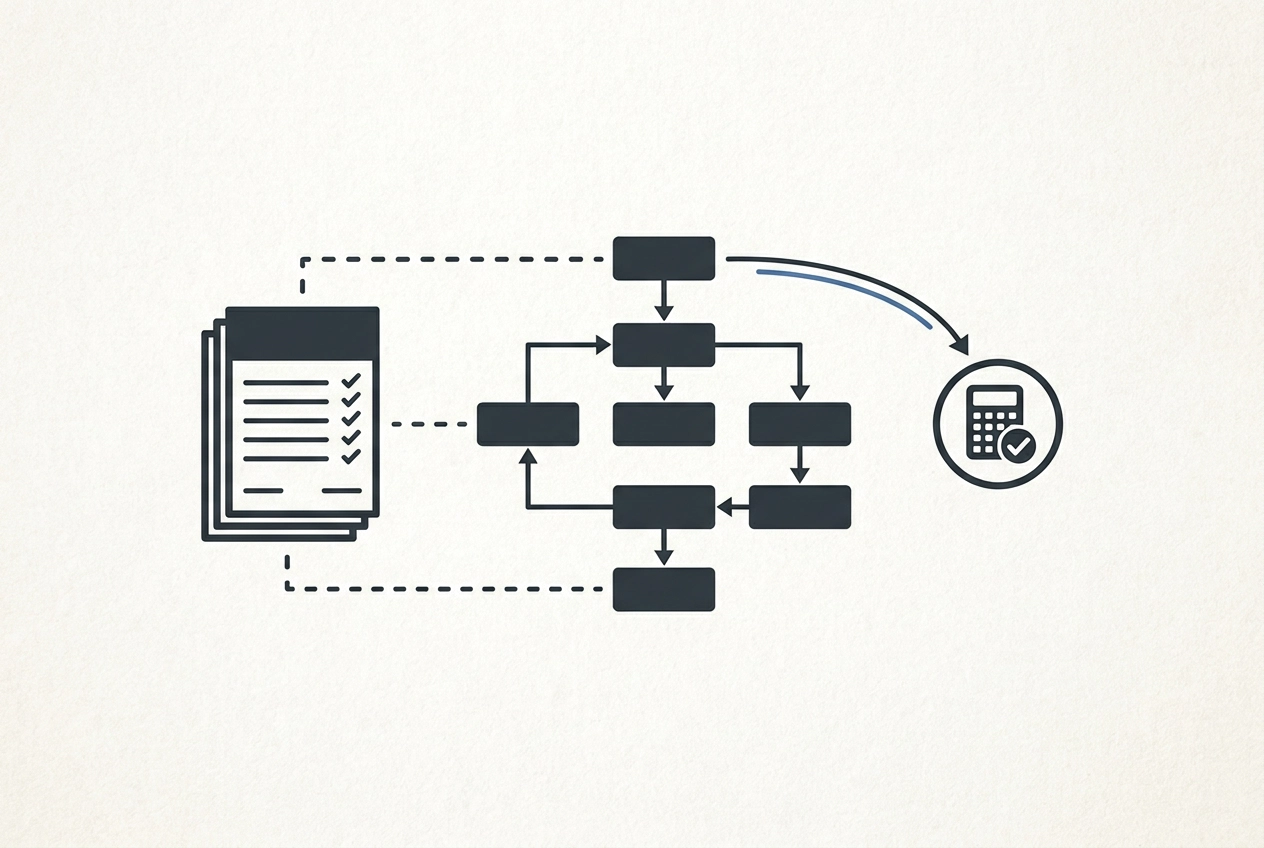
Draw a one page map of how a job moves from first call to final payment. One page, by hand. Then mark every place information is written down or typed twice. That map, not a product demo, tells you what you actually need.
Remove Waste Before You Automate
Consolidate duplicate fields. Stop printing what is already digital. Set one place where a job's status lives so nobody has to ask where the job stands. These are Lean basics: extra processing and double entry are waste in an office the same way they are on a factory floor. Automating them only makes them happen faster and harder to see. The same discipline behind Fix the Process Before You Add Technology applies here.
Then Match the Tool to the Process
Once the map is clean, choose a tool that fits it. That is where crew&cost comes in for trade contractors: job costing, bids, invoices, and crew and license tracking in one place. Its smart bidding feature uses the real labor and cost history from past jobs to inform new bids, so pricing rests on what the work actually cost rather than on memory. Custom Builds fit a different shape of problem: client and job tracking, inventory and product tracking, or booking and intake, configured around how the business already works instead of forcing the business into a template.
Wire the Pieces Together
The connecting step matters as much as the software. If the schedule, the accounting, and the job list all hold the same customer, wire them together so the address gets typed once and only once. Every hand-typed copy is a chance to lose the number, and a lost number is a bid that comes in wrong.
What This Looks Like for an East Alabama or West Georgia Shop
You run a shop of 1 to 25 people in trades, services, retail, or a nonprofit, somewhere around Heflin, in East Alabama, or just across the line into West Georgia. The owner still answers the phone and prices the jobs. Office work happens after the crew goes home. The "system" is one person's memory plus three spreadsheets that only that person understands. If that sounds familiar, Where to Start If Your Shop Runs on Spreadsheets and Texts is the right place to begin.
The First Month: Map One Job Type
Pick your most common job type. Pick one, not all of them. Trace it from first call to final payment and write down every place a number gets entered. The address on the estimate, the same address on the invoice, the same address again in the truck's GPS. Hours on a paper ticket, then typed into a spreadsheet, then typed into a bill. Material cost copied off a receipt, then copied again.
You will end up with a list of seams: the handoff points where information leaves one tool and lands in another. Circle the two that cost the most time. Usually that is the bid handoff to the crew and the hours handoff to the invoice. Close those two first. No software purchase is required for this step.
The Second Month: One Place Two People Can See
Move jobs, customers, and bids into a single place that two people can open. Not one person's file. Two people, at the same time, seeing the same job status. Then connect the accounting or scheduling tool already in use so the customer name and address get typed once and only once. This is the part most shops skip, and it is the part that stops the double entry.
A Note on Geography
The figures here are Alabama-level; West Georgia readers should treat them as regional context.
Where to Start
You do not need to transform your business. Walk through how your shop tracks jobs today, first call to final payment, and count the re-entry points. Or pull your last five bids and compare them against what those jobs actually cost in labor and material. Either one tells you more than any software demo will.
Conclusion: Four Things to Do This Week
The key figure: 390,228 of Alabama's 465,610 small businesses have no employees. This economy runs on owner-operators. It is not mostly enterprises with departments and documented process. It is owner-operators doing the work and the paperwork in the same day. Here are four things to do this week, in order.
Trace one job type from first call to final payment. Pick the job type you sell most often, not the biggest or the strangest one. Write down every place a number gets typed, copied, or read off a phone screen. Do not fix anything yet. Just count the stops.
Close the two seams that cost the most time. Look at the list and find where the same information gets entered twice, or where a detail gets lost between two people. Fix those two first. Do that before you shop for software. A tool dropped on a broken handoff just moves the mess somewhere new.
Get jobs, customers, and bids into one place two people can see. That single change removes the dependency on one person's memory. When the job list lives somewhere shared, a second person can answer a customer without asking the owner first.
Keep spreadsheets for analysis; move shared, live job data somewhere two people can see it at once.
If you want to start at step one, walk through how your shop tracks a job today, or compare your current bid numbers against what the last similar job actually cost.